Field Notes
The Reviewer’s Blind Spot: Why Tech Journalism Ignores the Only Metric That Matters
Product reviews are increasingly obsessed with initial thrills while ignoring the long-term reliability issues that actually define the consumer experience.
Numerous Times Field Notes
Dispatches from inside the room
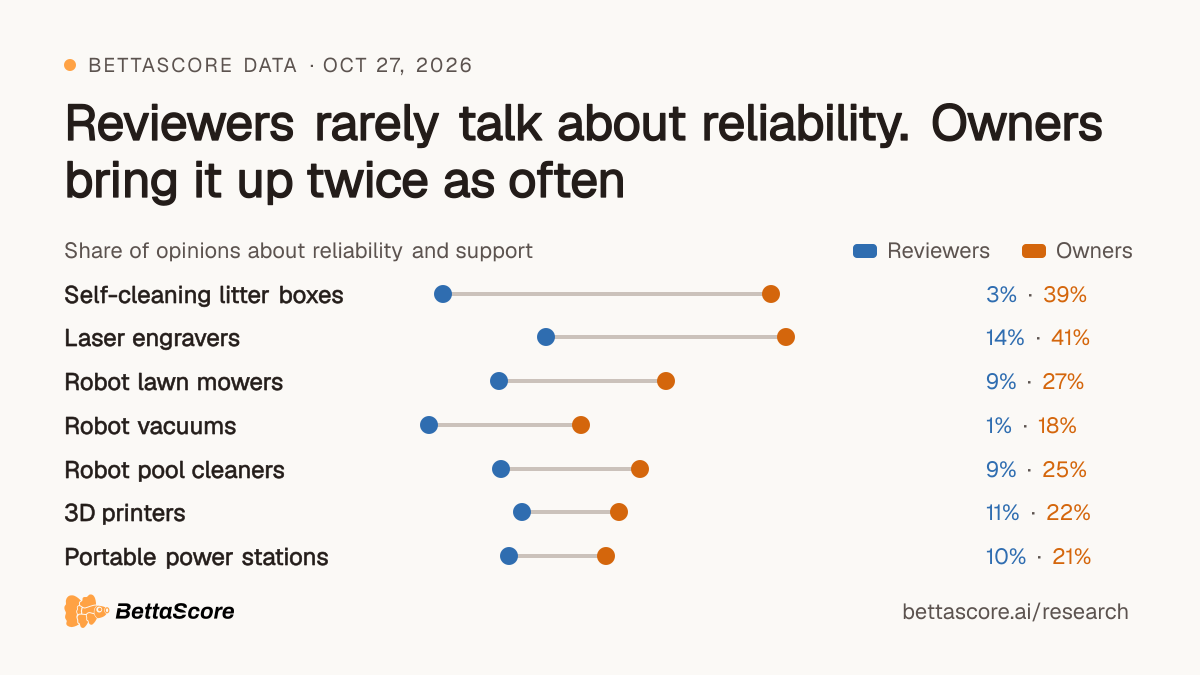
A recent data analysis from Bettascore has confirmed what every frustrated consumer already suspected: professional product reviewers and actual owners are living in two different worlds. While critics obsess over frame rates, bezel thickness, and tactile feedback, the people who actually pay for these gadgets are shouting into the void about whether the hardware will still function in six months. The data shows that owners mention reliability twice as often as professional reviewers do. This isn't just a difference in perspective; it is a fundamental failure of the tech press.
For decades, the industry has operated on the 'launch window' model. A reviewer receives a pristine unit, tests it in a controlled environment for seventy-two hours, and publishes a verdict before the first software patch even hits. This creates a feedback loop that rewards novelty over durability. The background of this problem lies in the shift from hardware being a lifelong investment to a disposable service. When products were analog, build quality was self-evident. Now, with complex firmware and planned obsolescence, a device’s true character doesn't emerge until the honeymoon phase is long over.
This matters because the gap between 'out-of-the-box' excellence and 'month-six' failure is where consumer trust goes to die. When a flagship smartphone wins 'Editor’s Choice' awards despite a history of thermal throttling or hinge failures that manifest after ninety days, the review serves the manufacturer, not the reader. We have allowed the 'unboxing' culture to replace rigorous stress testing. By focusing on the immediate dopamine hit of a new feature, reviewers are effectively acting as an extension of a brand's marketing department rather than a consumer advocate.
We need to stop treating tech reviews like movie critiques and start treating them like civil engineering reports. Reliability is not a secondary feature; it is the foundation upon which all other features sit. A camera that takes breathtaking photos is worthless if the motherboard fries itself after a year of heavy use. Yet, the current incentive structure for digital media prioritizes being first over being right.
Watch for a potential shift toward 'living with it' long-term reviews, but don't hold your breath. As long as the algorithm demands instant gratification and click-throughs on launch day, the burden of proof will remain on the buyer. The next time you read a glowing assessment of a thousand-dollar device, ask yourself why the critic is silent on the one thing that will determine if you regret the purchase: will it actually last?
One essay. Every Friday. From operators who actually run things.
Join thousands of founders, partners, and operating leaders. No filler. Unsubscribe anytime.
Reader notes
0 NotesSign in to comment. Comments are signed and public.
Sign in →