Field Notes
The Hallucination Is the Interface: Why We Should Stop Chasing Precision
A new project training neural networks to mimic terminal environments suggests that the future of computing isn't in rigid logic, but in believable simulation.
Numerous Times Field Notes
Dispatches from inside the room
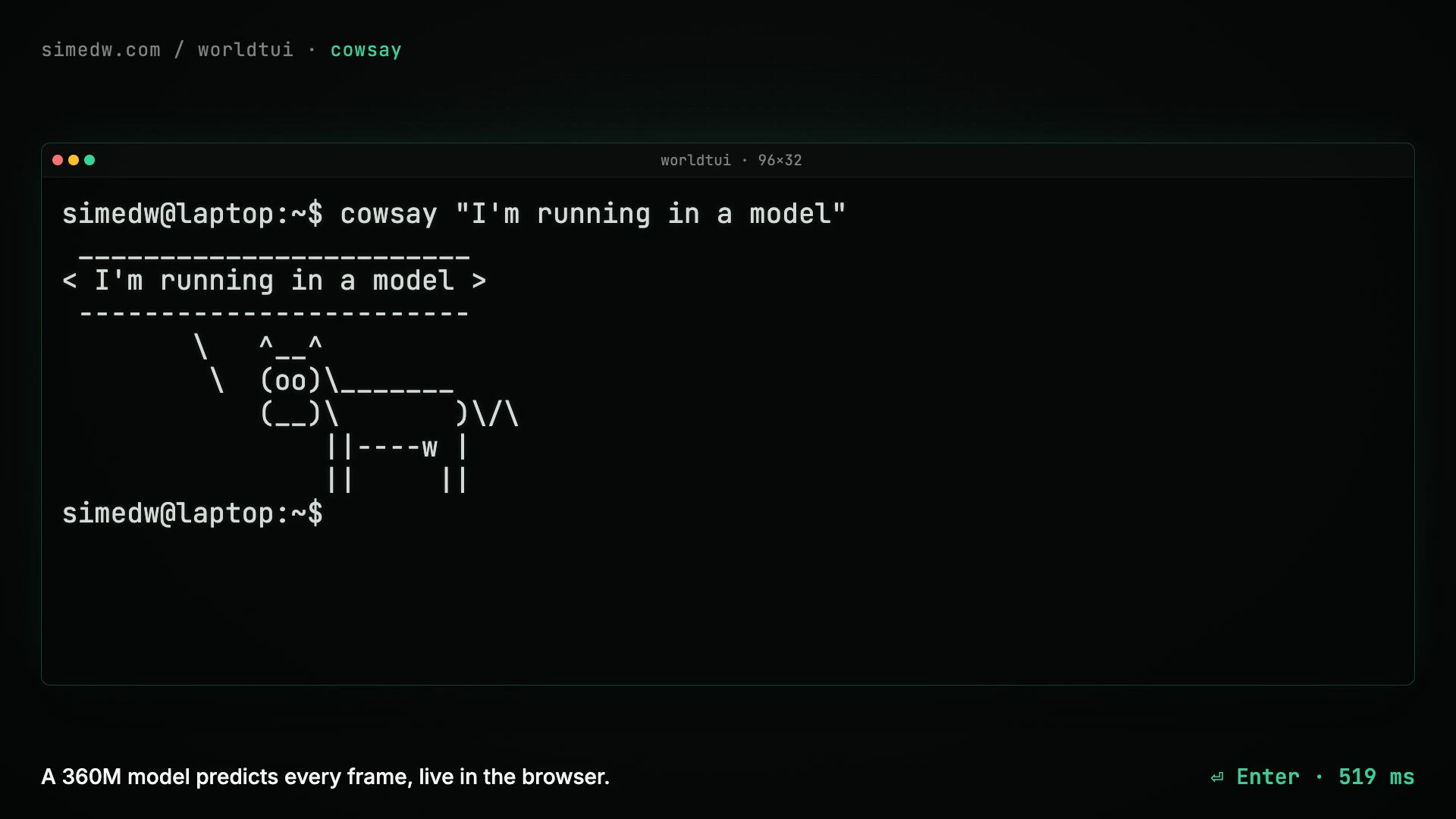
We have spent sixty years demanding that computers be literal. From the first punched cards to the latest command-line interfaces, the contract between human and machine has been one of unforgiving syntax. If you miss a semicolon, the world stops. But this week, a developer operating under the handle Simedw demonstrated that the walls between logic and imagination are finally dissolving. By training a modest 360-million parameter model specifically to act as a terminal interface—a project dubbed WorldTUI—they have proven that a machine doesn't need to understand a file system to convincingly simulate one.
This isn't a shell wrapper for an LLM; it is a world model. When you type a command into this interface, there is no underlying Linux kernel executing the code. Instead, the neural network predicts what a terminal *ought* to look like after such a command is issued. It is a dream of a computer, running on a computer. While traditionalists might scoff at the idea of a terminal that can literally hallucinate a directory into existence, they are missing the seismic shift in how we define utility.
For decades, the industry has chased the 'Correctness God.' We wanted models that were 100% accurate, fearing that any deviation from objective reality would render them useless. WorldTUI turns that anxiety on its head. By focusing on a constrained environment—the text-based world of the terminal—it shows that for many tasks, the feeling of the environment is as important as the logic. We are moving toward a period where the interface is the engine. If a model can maintain a consistent internal state of a file structure, does it matter if that structure exists on a physical disk?
This matters because it signals the end of the 'tool' era and the beginning of the 'environment' era. When our operating systems become world models, the friction of syntax disappears. You aren't learning a language to talk to a chip; you are participating in a shared simulation where the computer anticipates your intent. The brilliance of this 360M model lies in its efficiency—it proves you don't need a trillion parameters to create a convincing reality, just a specific focus.
Watch the developer community's reaction carefully. The next step isn't just better chatbots; it is the development of 'imaginary stacks' where entire workflows—from coding to deployment—happen inside a persistent, simulated environment that needs no backend. The rigid binary of 'true or false' is dying. In its place, we are building machines that understand the vibes of our data better than the data itself.
One essay. Every Friday. From operators who actually run things.
Join thousands of founders, partners, and operating leaders. No filler. Unsubscribe anytime.
Reader notes
0 NotesSign in to comment. Comments are signed and public.
Sign in →