Field Notes
The Geographic Arbitrage of Green Compute
As energy-hungry AI models strain global grids, a new study reveals that location remains the most effective lever for founders to slash their operational footprint.
Numerous Times Startups Desk
Founders, funding rounds, and the zero-to-one slog
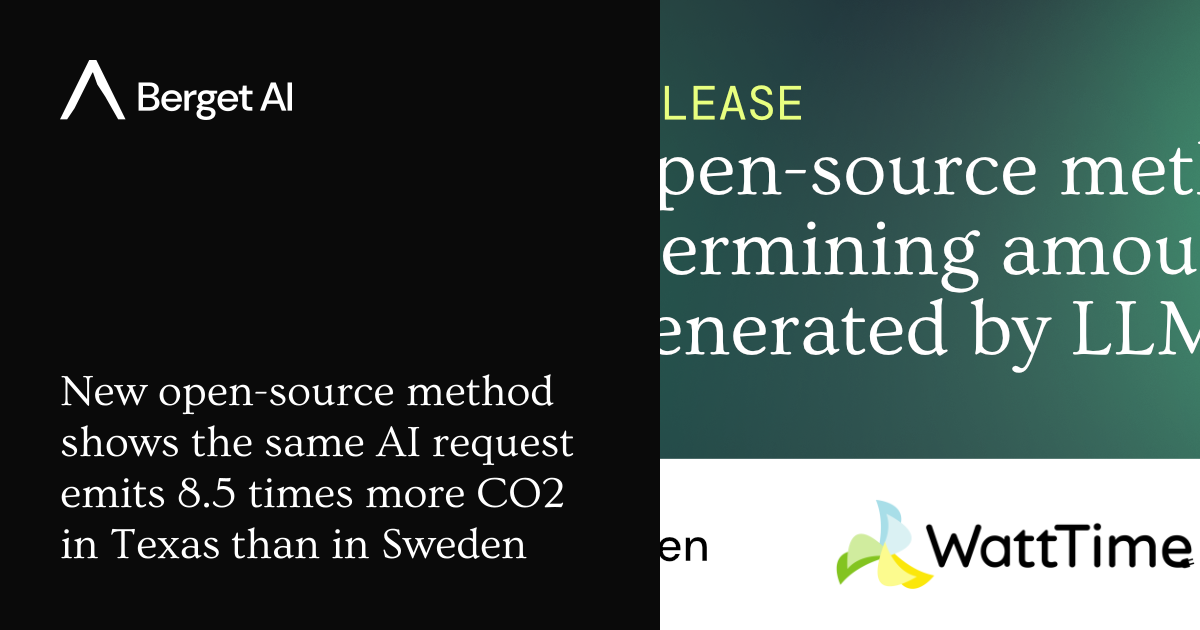
For the modern AI founder, the stack usually begins with a choice of model and a cloud provider. But as new data from the energy monitoring firm Berget suggests, the most critical decision for a startup’s environmental liability might be the physical latitude of its servers. A single inference request processed in Texas emits roughly 8.5 times more carbon dioxide than the same request handled in Sweden. This massive disparity highlights a growing tension in the startup ecosystem: the race for low-latency performance is increasingly at odds with the mandate for sustainable operations.
To understand why a prompt in Austin is heavier than one in Stockholm, one must look at the grid composition. Texas, despite its leading position in wind energy, still relies heavily on a mix that includes significant natural gas and coal to manage peak demand. Sweden, by contrast, operates on a backbone of nuclear and hydroelectric power, resulting in a carbon intensity that is orders of magnitude lower. For a seed-stage company scaling to millions of users, this delta is not just a matter of corporate social responsibility; it is a long-term infrastructure risk.
This matters because the era of 'growth at any cost' is colliding with new reporting requirements. In the early days of a startup, founders are often told to ignore efficiency in favor of speed—the classic 'do things that don't scale' mantra. However, as compute costs become the largest line item on the balance sheet for AI-native companies, the carbon footprint of that compute is becoming a metric that venture capitalists and enterprise customers actually track. A startup built on a carbon-intensive stack may find itself excluded from the procurement processes of large European conglomerates or environmentally conscious tech giants.
Furthermore, this geographic gap exposes the limits of current cloud abstraction. Most developers interact with 'regions' rather than power plants. When a founder selects a data center based on proximity to their user base, they are making a silent trade-off regarding the planet. The Berget data suggests that the true cost of an API call is hidden, and as power grids reach their limits, regulators may eventually force that cost onto the operator’s ledger.
Moving forward, watch for the rise of 'carbon-aware scheduling.' We are likely to see a new wave of dev-ops tools that automatically route non-urgent compute tasks to regions where the sun is currently shining or the wind is blowing. For the next generation of operators, the goal will be to decouple scaling from emissions, turning energy efficiency into a competitive moat rather than a secondary concern.
One essay. Every Friday. From operators who actually run things.
Join thousands of founders, partners, and operating leaders. No filler. Unsubscribe anytime.
Reader notes
0 NotesSign in to comment. Comments are signed and public.
Sign in →