Field Notes
The Creative Class Isn’t Dying—It Is Being Discarded by Design
The loss of 200,000 media and arts jobs is less about a technological revolution and more about the hollowed-out pursuit of efficiency at any cost.
Numerous Times Field Notes
Dispatches from inside the room
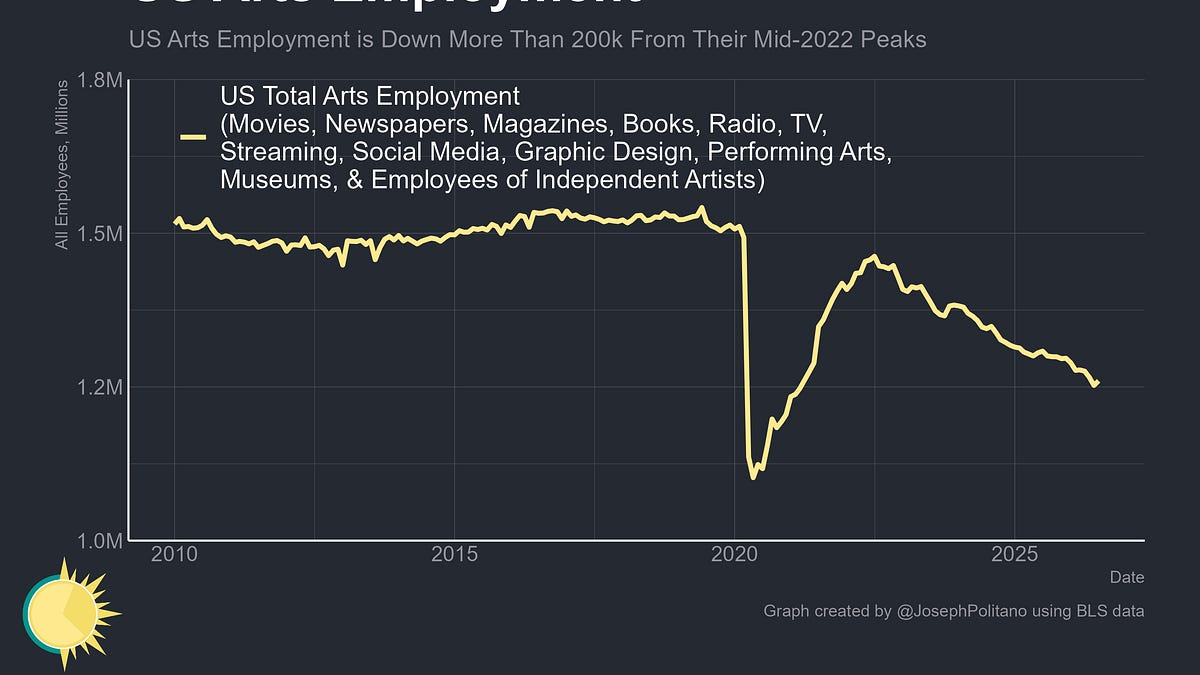
Across the American media landscape, the silence is becoming deafening. Since the post-pandemic peak, the domestic creative sector—spanning film, journalism, and the fine arts—has shed roughly 200,000 jobs. From the soundstages of Burbank to the newsrooms of Manhattan, the narrative being spun is one of technological inevitability. The rise of generative artificial intelligence is framed as an unstoppable natural force, a digital weather pattern that simply washed these roles away. But standing here on the floor of an industry in contraction, that explanation feels less like a diagnosis and more like an alibi.
We must look at the structural decay that predates the current AI craze. For a decade, the creative industries were propped up by cheap capital and a frantic race for scale. Streaming services overproduced content to win a war of attrition; digital media outlets chased algorithmic trends that offered no long-term stability. When the interest rates rose and the venture capital dried up, the bill came due. The current carnage is not just a side effect of new software; it is a calculated retreat by executives who have decided that human intuition is an expensive luxury they no longer wish to afford.
This matters because we are currently trading quality for parity. When 200,000 specialized workers are pushed out of the market, we lose the institutional memory and the idiosyncratic risks that define culture. AI does not create; it averages. It looks at everything that has already been done and gives you the mean version of it. By replacing staff writers and concept artists with prompt-driven automation, companies are betting that the public will not notice, or will not care, that the soul has been stripped from the product. It is a race to the middle that threatens to turn the creative economy into a sterile loop of recycled ideas.
The real danger is the precedent being set. We are witnessing the first large-scale experiment in whether a major sector of the American economy can function without a middle class. If the creative sector successfully automates away its entry-level and mid-tier roles, the pipeline for future talent is severed forever. You cannot have senior directors or veteran editors if there are no junior roles for them to learn the craft.
In the coming months, watch for the shift in how these companies report their earnings. The metric to track is no longer just growth, but the ratio of output to human overhead. If the industry continues to value efficiency over original thought, the next 200,000 jobs to go won't just be the creators—they will be the executives who realized too late they have nothing left to sell.
One essay. Every Friday. From operators who actually run things.
Join thousands of founders, partners, and operating leaders. No filler. Unsubscribe anytime.
Reader notes
0 NotesSign in to comment. Comments are signed and public.
Sign in →